IASO206
Clinical Development Plan in Multiple Myeloma
BCMA-targeted in vivo CAR-T Cell Therapy
| Item | Description |
|---|---|
| Version / Date | Version 1.4, 18 June 2026 |
| Sponsor | IASO Bio |
| Document Type | English version translated and updated from the Chinese V1.4 clinical development plan |
| Indication | Relapsed or refractory multiple myeloma (RRMM) |
| Product | IASO206, BCMA-targeted in vivo CAR-T |
Confidential – for strategic clinical development planning
Revision History
| Version | Date | Summary of Changes |
|---|---|---|
| 1.0 | 26 Apr 2026 | Initial version. |
| 1.1 | 18 Jun 2026 | Updated competitive landscape, key in vivo CAR-T clinical data, Kelonia/Lilly transaction, recent FDA approvals, and clinical positioning. Added Ib/II and Phase III design recommendations, FDA/EMA/NMPA regulatory discussion topics, Go/No-Go criteria and risk mitigation. |
| 1.2 | 18 Jun 2026 | Updated based on advisory consensus: a global single-arm pivotal trial in >=4L RRMM may be acceptable; a global program should cover the US, EU and other regions; the control arm in earlier-line randomized study can allow regional SOC; MRD negativity and PFS are key efficacy endpoints; conditional/accelerated approval should be sought based on the >=4L program. |
| 1.3 | 18 Jun 2026 | Reverted the 1-3L RRMM randomized study to a Phase III confirmatory study and removed the randomized Phase II validation step. |
| 1.4 | 18 Jun 2026 | Updated the two patient populations in the >=4L global single-arm pivotal study from prior CD38-exposed / CD38-unexposed to prior BCMA-targeted therapy / BCMA-targeted therapy-naive. Synchronized the update across the executive summary, clinical strategy, regulatory discussion, Go/No-Go criteria and risk mitigation sections. |
Executive Update Summary (V1.4, 18 June 2026)
Version 1.4 further focuses the IASO206 clinical development pathway in multiple myeloma. In >=4L RRMM, a global single-arm pivotal study is considered an acceptable first registration pathway. In 1-3L RRMM, the program should proceed directly to a randomized Phase III confirmatory study; a randomized Phase II validation study is no longer recommended. A direct head-to-head comparison with ex vivo CAR-T is not considered necessary.
IASO206 should consider one global clinical program covering the United States, the European Union and other major markets. The >=4L RRMM single-arm pivotal study should include two clinically relevant patient populations: patients with prior BCMA-targeted therapy and patients who are BCMA-targeted therapy-naive. The 1-3L RRMM study should evaluate single-administration IASO206 versus investigator-selected regional standard of care (SOC).
Key external changes remain important for the program: BCMA bispecific antibodies are moving to earlier lines; teclistamab plus daratumumab has been approved by FDA for RRMM after at least one prior line; belantamab mafodotin returned through combination regimens with ocular toxicity remaining a key limitation; linvoseltamab has strengthened late-line BCMA bispecific competition; KLN-1010 has provided additional early clinical validation for in vivo CAR-T; and the Eli Lilly/Kelonia transaction highlights the strategic value of the in vivo CAR-T platform.
The core evidence package should prospectively capture in vivo CAR-T generation and persistence, MRD negativity and sustained MRD negativity, PFS, DOR, ORR/CR/sCR, reduced burden from no lymphodepletion, infections and IVIG use, outpatient feasibility, and long-term monitoring for insertional mutagenesis and RCL/RCR. MRD negativity and PFS are recommended as co-primary efficacy endpoints for the 1-3L randomized Phase III confirmatory study. IASO should seek conditional or accelerated approval under the >=4L pathway before or in parallel with the Phase III program.
Table of Contents
1. BCMA Target and Related Therapeutic Product Analysis
1.1 BCMA biology, expression profile and therapeutic rationale
1.2 BCMA-targeted therapeutic modalities: ADC, bispecific antibodies, ex vivo CAR-T and in vivo CAR-T
1.3 IASO206 product features and technical differentiation
1.4 Competitive product comparison
2. Business Value in China and the United States
2.1 Epidemiology and target population sizing
2.2 Quantified unmet medical need
2.3 Competitive landscape by line of therapy and product class
2.4 Market share and value assumptions
3. Clinical Trial Plan
3.1 Overall development plan
3.2 Clinical development stages
3.3 Trial planning details
3.4 Updated IASO206 MM clinical development strategy
4. Regulatory Considerations
4.1 Pre-IND/Scientific Advice strategy
4.2 IND/CTA plans
4.3 Global regulatory communication plan
4.4 Regulatory policy trends
4.5 International registration plan
4.6 Updated FDA/EMA/NMPA/PMDA regulatory positioning
5. Strategic Plan
5.1 Milestones and key evidence generation
5.2 Decision points
5.3 Continue/terminate criteria
5.4 Risk assessment and mitigation
5.5 Partnerships, licensing and commercial expansion
5.6 Updated Go/No-Go standards and Eque-cel synergy
References
1. BCMA Target and Related Therapeutic Product Analysis
1.1 BCMA Biology and Therapeutic Rationale
B-cell maturation antigen (BCMA), also known as TNF receptor superfamily member 17 (TNFRSF17) or CD269, is one of the most clinically validated targets in multiple myeloma (MM). BCMA is mainly expressed on mature B cells, plasma cells and malignant plasma cells, while it is largely absent from hematopoietic stem cells and most normal tissues. This restricted expression profile makes BCMA a highly attractive therapeutic target for MM.
BCMA binds two ligands, B-cell activating factor (BAFF) and a proliferation-inducing ligand (APRIL). These interactions activate NF-kappaB, MAPK and PI3K/Akt signaling pathways and support plasma-cell survival, proliferation and differentiation. In MM, BCMA overexpression is associated with malignant plasma-cell survival, drug resistance and disease progression. Soluble BCMA (sBCMA), generated by gamma-secretase cleavage, can reflect tumor burden and may also interfere with BCMA-targeted therapies through competitive binding.
Compared with CD38 and SLAMF7, BCMA provides a more selective plasma-cell lineage target. CD38 is expressed on MM cells but also on erythrocytes, platelets and several immune-cell subsets. SLAMF7 is also broader than BCMA and is expressed on NK cells and some T cells. The strong and relatively selective BCMA expression in MM supports the use of ADCs, bispecific T-cell engagers and CAR-T approaches.
1.2 BCMA-targeted Therapeutic Modalities
1.2.1 Antibody-drug Conjugates (ADC)
BCMA-directed ADCs combine a BCMA-binding antibody with a cytotoxic payload. Belantamab mafodotin is the benchmark BCMA ADC. It demonstrated activity in RRMM but was limited by corneal toxicity and regulatory uncertainty after the DREAMM-3 result. More recent combination data have re-established belantamab as a relevant competitor in combination regimens, but ocular toxicity and monitoring requirements remain important limitations.
1.2.2 Bispecific Antibodies / T-cell Engagers
BCMA x CD3 bispecific antibodies recruit endogenous T cells to BCMA-expressing myeloma cells. Teclistamab, elranatamab and linvoseltamab have established the therapeutic value of BCMA T-cell redirection. Their major advantages are off-the-shelf availability and no requirement for leukapheresis; however, repeated dosing, infection risk, hypogammaglobulinemia, IVIG use and cumulative treatment burden are key differentiating challenges for a one-time in vivo CAR-T product.
Table 1. Approved BCMA bispecific antibodies
| Product | Company | Route | Key late-line efficacy | Strategic note |
|---|---|---|---|---|
| Teclistamab (Tecvayli) | Johnson & Johnson | SC | ORR approximately 62%; CR/sCR increases with longer follow-up | Moving earlier in combination with daratumumab; infection and long-term dosing burden remain important. |
| Elranatamab (Elrexfio) | Pfizer | SC | ORR approximately 61%; CR/sCR approximately 32% | Can transition to less frequent dosing in responders; still requires ongoing therapy. |
| Linvoseltamab (Lynozyfic) | Regeneron | IV/step-up then maintenance | ORR approximately 71%; CR/sCR approximately 45%; durable responses reported | Strong late-line competitor; dosing interval can be extended in deep responders. |
1.2.3 Ex vivo CAR-T Cell Therapy
Ex vivo BCMA CAR-T therapies are the most clinically mature BCMA-directed cell therapies. Ide-cel, cilta-cel, equecabtagene autoleucel (Eque-cel) and zevor-cel have demonstrated deep responses in RRMM. Despite high efficacy, ex vivo CAR-T is limited by leukapheresis, individualized manufacturing, vein-to-vein time, manufacturing failure, lymphodepletion, limited center capacity and cost. These limitations create a major opportunity for a scalable in vivo CAR-T product.
Table 2. Approved BCMA CAR-T products
| Product | Company | Current main positioning | Key data / comments |
|---|---|---|---|
| Ide-cel (Abecma) | BMS / bluebird bio | RRMM after multiple prior lines; also earlier-line expansion in some regions | KarMMa showed meaningful activity with ORR around 73% and CR/sCR around 33%; requires leukapheresis and lymphodepletion. |
| Cilta-cel (Carvykti) | Janssen / Legend | Expanded into earlier RRMM after at least one prior line in lenalidomide-refractory disease | CARTITUDE program demonstrated very deep responses; strongest ex vivo benchmark. |
| Eque-cel (Fucaso) | IASO Bio / Innovent (commercial collaboration historically referenced) | Approved in China for RRMM after at least three prior lines | FUMANBA-1 showed ORR around 96% and CR/sCR around 74%; important IASO commercial and scientific asset. |
| Zevor-cel | CARsgen / Huadong Medicine | Approved in China for RRMM after at least three prior lines | High ORR in Chinese registration study; another China-market ex vivo comparator. |
1.2.4 In vivo CAR-T Cell Therapy
In vivo CAR-T seeks to generate CAR-T cells directly inside the patient through systemic delivery of a gene-transfer vector, such as a targeted lentiviral vector or lipid nanoparticle. It is designed to eliminate leukapheresis, ex vivo cell culture and individualized manufacturing, and may avoid lymphodepletion. IASO206 belongs to this emerging class of BCMA-targeted in vivo CAR-T products.
Early clinical proof-of-concept from ESO-T01 and KLN-1010 supports the feasibility of in vivo generation of BCMA-directed CAR-T cells without conventional ex vivo manufacturing. Early datasets remain small and require longer follow-up, but they validate key concepts: systemic administration, in vivo CAR-T expansion, deep early responses, MRD negativity in responders and manageable CRS/ICANS profiles.
The strategic implication for IASO206 is clear: the program should not compete only on early ORR. It should prospectively build a full evidence chain around in vivo generation, persistence, MRD depth, durability, outpatient feasibility, lower infection/IVIG burden, scalability and long-term gene-therapy safety.
1.3 IASO206 Product Features and Technical Differentiation
Innovative vector design: IASO206 uses an optimized self-inactivating lentiviral vector carrying a BCMA CAR transgene and designed for selective in vivo transduction of circulating T cells.
Efficient transduction and persistent expression: Preclinical data should support robust T-cell transduction, BCMA-specific cytotoxicity, cytokine production and persistence after systemic administration.
Optimized CAR structure: The product uses a BCMA-binding domain, hinge/transmembrane region, 4-1BB costimulatory domain and CD3zeta signaling domain, aiming to generate memory-like CAR-T cells with durable activity.
Simplified administration: Single intravenous administration without leukapheresis, ex vivo manufacturing or lymphodepletion is the central differentiation versus autologous CAR-T.
Potentially lower treatment burden: Avoiding lymphodepletion may reduce cytopenia, infection risk, hospitalization and IVIG burden.
Scalable manufacturing: Batch-produced viral-vector manufacturing may support broader access, lower cost and better commercial scalability than individualized cell manufacturing.
1.4 Competitive Product Comparison
Table 3. Competitive landscape for BCMA-targeted therapies
| Product / class | Mechanism | Administration | Strengths | Key limitations / implications for IASO206 |
|---|---|---|---|---|
| IASO206 | BCMA-targeted in vivo CAR-T (lentiviral vector) | Single IV administration | No leukapheresis, no ex vivo manufacturing, no lymphodepletion; scalable and potentially outpatient | Must demonstrate in vivo generation, durable MRD-negative responses, vector safety and cross-regional regulatory acceptability. |
| Cilta-cel / ide-cel / Eque-cel | Ex vivo BCMA CAR-T | Single infusion after manufacturing and lymphodepletion | Deep responses and long PFS in selected patients | Access, manufacturing, lymphodepletion and cost limitations; direct head-to-head comparison is not required but differentiation must be clear. |
| Teclistamab / elranatamab / linvoseltamab | BCMA x CD3 bispecific antibodies | Step-up dosing and continuous treatment | Off-the-shelf, no cell manufacturing | Long-term repeated dosing, infections, hypogammaglobulinemia and IVIG burden create opportunity for one-time therapy. |
| Belantamab combinations | BCMA ADC-based combinations | Repeated IV dosing | Non-T-cell redirection mechanism, useful in combinations | Ocular toxicity and monitoring burden. |
| GPRC5D / FcRH5 therapies | Alternative T-cell redirection targets | Repeated dosing or cell therapy | Useful after BCMA exposure/resistance | IASO206 should define role in BCMA-naive and post-BCMA settings. |
2. Business Value in China and the United States
2.1 Epidemiology and Target Population Sizing
Multiple myeloma is the second most common hematologic malignancy. It is characterized by clonal plasma-cell expansion in bone marrow and end-organ damage including hypercalcemia, renal insufficiency, anemia and bone disease. Incidence increases strongly with age, and the disease burden is expected to rise with population aging in both China and the United States.
In the United States, annual new MM cases are approximately in the mid-30,000 range, with a large prevalent population due to improved survival. In China, the age-standardized incidence is lower than in Western countries, but the large population base results in substantial annual new cases. Chinese patients may present with later stage disease and renal impairment more frequently, which increases the need for effective and accessible therapies.
IASO206 is initially positioned for RRMM. The strongest early commercial and regulatory opportunity is in >=4L RRMM where existing options are limited, patient attrition is high, and access to ex vivo CAR-T is constrained. The longer-term value lies in 1-3L RRMM, particularly lenalidomide-refractory and BCMA-naive populations.
Table 4. Indicative target population framework
| Population | United States | China | Relevance to IASO206 |
|---|---|---|---|
| Annual new MM cases | Approximately 35,000+ | Approximately 30,000-35,000 | Base incidence pool for future lines of therapy. |
| >=2L RRMM | Large annual population | Large annual population | Potential future expansion area. |
| >=3L / >=4L RRMM | Core late-line immune-therapy segment | Core late-line immune-therapy segment | First global single-arm pivotal pathway. |
| Patients eligible for CAR-T but not treated | Substantial access gap | Even larger access gap | Strong value proposition for in vivo, scalable product. |
| 1-3L lenalidomide-refractory, BCMA-naive RRMM | High strategic value | High strategic value | Randomized Phase III confirmatory opportunity. |
2.2 Quantified Unmet Medical Need
Clinical outcomes deteriorate with each additional line of therapy; late-line conventional regimens have limited ORR, short PFS and poor OS.
Triple-class exposed or refractory patients have particularly poor outcomes and limited durable options.
Ex vivo CAR-T provides deep responses but is constrained by leukapheresis, manufacturing time, center capacity, lymphodepletion, cost and manufacturing failure.
Continuous T-cell-engaging antibodies are accessible but impose long-term dosing, infection monitoring, hypogammaglobulinemia, IVIG use and cumulative healthcare burden.
IASO206 directly addresses access, scalability and treatment-burden gaps while aiming to preserve the depth and durability of CAR-T biology.
2.3 Current Competitive Landscape
The RRMM landscape is rapidly shifting from PI/IMiD/CD38 combinations to immune-redirection therapies. In front-line NDMM, quadruplets such as D-VRd and Isa-VRd continue to strengthen CD38-based standards. In first relapse, regimen choice depends on lenalidomide refractoriness, CD38 exposure, disease aggressiveness and regional availability. In third line and beyond, BCMA CAR-T, BCMA bispecifics and GPRC5D-targeted agents increasingly dominate treatment algorithms. IASO206 should therefore position itself not only as another BCMA therapy but as a one-time, scalable, potentially outpatient immune-cell therapy.
2.4 Market Share Assumptions
| Scenario | US market share at maturity | China market share at maturity | Key assumptions |
|---|---|---|---|
| Conservative | 8-12% | 15-20% | Slower approval, stronger incumbent advantage, limited differentiation versus other in vivo CAR-T or bispecific therapies. |
| Base case | 15-20% | 25-30% | Timely approval, clinically meaningful efficacy, favorable safety, lower treatment burden and pricing below ex vivo CAR-T. |
| Upside | 25-30% | 35-45% | Clear superiority in access, safety burden and durable MRD-negative responses; successful earlier-line expansion. |
2.5 Market Value Assumptions
Pricing should reflect the value of a one-time CAR-T-like therapy while acknowledging lower manufacturing complexity versus autologous CAR-T. In the United States, a price below ex vivo CAR-T but above annualized bispecific therapy may be justified if durability is proven. In China, lower pricing and reimbursement strategy will be central to uptake. A successful 1-3L randomized Phase III program would materially expand the peak-sales opportunity.
3. Clinical Trial Plan
3.1 Overall Development Plan
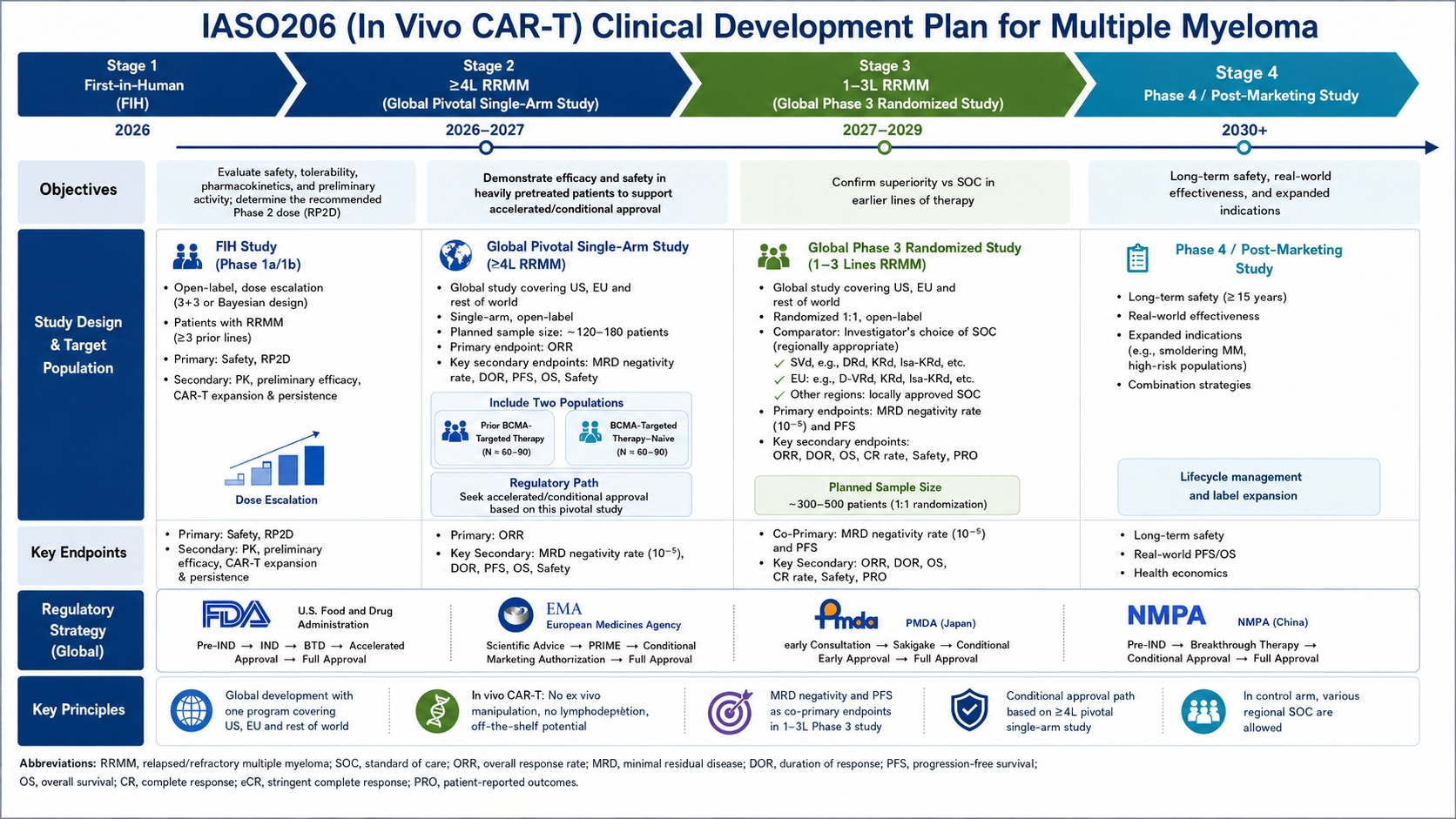
The recommended IASO206 development sequence is: first, complete China FIH/Ib dose escalation and dose expansion to establish the safety window, in vivo CAR-T generation and candidate RP2D; second, incorporate the United States, European Union and other regions into one global clinical program; third, conduct a >=4L RRMM global single-arm pivotal study with two prespecified populations: prior BCMA-targeted therapy and BCMA-targeted therapy-naive; fourth, seek conditional or accelerated approval based on the >=4L global pivotal evidence; fifth, directly conduct a 1-3L randomized Phase III confirmatory study comparing IASO206 with investigator-selected regional SOC.
The program should prioritize a clear differentiation package: one-time treatment, no leukapheresis, no ex vivo manufacturing, no lymphodepletion, in vivo CAR-T generation and persistence, deep MRD-negative responses, durable PFS, and reduced infection/IVIG/hospitalization burden versus continuous T-cell-engaging therapies.
Table 5. Recommended clinical development roadmap
| Stage | Study type | Population | Design | Primary purpose |
|---|---|---|---|---|
| Stage 1 | FIH / Ib dose escalation and expansion | RRMM; initially late-line, BCMA-targeted therapy-naive may be prioritized for mechanism demonstration | Open-label dose escalation and expansion | Define safety, DLT window, in vivo CAR-T generation, PK/PD and RP2D. |
| Stage 2 | Global single-arm pivotal study | >=4L RRMM with two cohorts: prior BCMA-targeted therapy and BCMA-targeted therapy-naive | Global, multicenter, open-label single-arm pivotal study | Support conditional / accelerated approval and establish late-line benefit. |
| Stage 3 | Randomized Phase III confirmatory study | 1-3L RRMM; lenalidomide-refractory and BCMA-naive preferred | IASO206 versus investigator-selected regional SOC; 1:1 randomization | Confirm long-term registrational value in earlier lines. |
| Stage 4 | Post-marketing / lifecycle management | Approved population and expansion populations | Long-term follow-up, RWE and additional studies | Support full approval, label expansion and safety monitoring. |
3.2 Clinical Development Stages
3.2.1 Phase I / FIH Study
Open-label, dose-escalation and dose-expansion design.
Key objectives: safety, tolerability, DLTs, CRS/ICANS characterization, in vivo CAR-T generation, vector biodistribution, viral shedding, RCL/RCR testing, insertion-site analysis and preliminary efficacy.
Candidate endpoints: incidence of DLTs, TEAEs/SAEs, CRS/ICANS grade and timing, CAR transgene copies, CAR+ T-cell proportion, serum cytokines, ORR, CR/sCR, MRD negativity, DOR and PFS.
Operational emphasis: outpatient feasibility, inpatient observation requirements, bridging therapy rules and management algorithms for CRS/ICANS.
3.2.2 Expansion / Global Pivotal Study in >=4L RRMM
The global single-arm pivotal study in >=4L RRMM is acceptable as the first registration-oriented pathway.
One global study is recommended to cover the United States, the European Union and other major markets whenever feasible.
Two prespecified patient populations should be included: patients with prior BCMA-targeted therapy and patients who are BCMA-targeted therapy-naive.
The design should use independent review committee (IRC) assessment and central MRD testing to strengthen cross-regional interpretability.
Key endpoints should include ORR, CR/sCR, MRD negativity, sustained MRD negativity, DOR, PFS, OS, safety, CRS/ICANS, infection, IVIG use, hospitalization burden and long-term gene-therapy safety.
Table 6. Proposed >=4L RRMM global single-arm pivotal design
| Element | Recommendation |
|---|---|
| Design | Global, multicenter, open-label, single-arm pivotal study. |
| Target population | >=4L RRMM; two prespecified cohorts: prior BCMA-targeted therapy and BCMA-targeted therapy-naive. |
| Sample size | Approximately 120-180 patients overall, with cohort-specific assumptions and thresholds; final size depends on regulatory feedback and expected ORR/CR/MRD/DOR. |
| Primary / key efficacy endpoints | ORR and/or CR/sCR with MRD negativity; DOR and PFS maturity are important for regulatory persuasiveness. |
| Key secondary endpoints | Sustained MRD negativity, PFS, OS, safety, CRS/ICANS, infections, IVIG use, hospitalization, PROs and treatment-free interval. |
| Regulatory intent | Support conditional or accelerated approval, then bridge to full approval through confirmatory evidence. |
3.2.3 Randomized Phase III Confirmatory Study in 1-3L RRMM
The 1-3L RRMM study should be a randomized Phase III confirmatory study; a randomized Phase II validation step is not recommended.
The target population may focus on lenalidomide-refractory, BCMA-naive RRMM, where clinical need and regulatory feasibility are strong.
A direct comparison with ex vivo CAR-T is not required. The control arm may allow investigator-selected regional SOC, such as DPd, PVd, DVd, DKd/Kd, Isa-Pd or other locally accepted strong SOC regimens.
MRD negativity and PFS are recommended as co-primary efficacy endpoints. Stratification factors should include prior lines, CD38 exposure or refractoriness, cytogenetic risk, ISS/R-ISS, renal function and region.
The suggested sample size is approximately 300-500 patients with 1:1 randomization, subject to statistical assumptions, event requirements and regulatory alignment.
Table 7. Proposed 1-3L randomized Phase III design
| Element | Recommendation |
|---|---|
| Population | 1-3L RRMM; lenalidomide-refractory and BCMA-naive preferred. |
| Design | Randomized, open-label, controlled Phase III confirmatory study; 1:1 randomization. |
| Experimental arm | IASO206 single intravenous administration at RP2D / recommended dose. |
| Control arm | Investigator-selected regional SOC; no requirement for ex vivo CAR-T comparator. |
| Co-primary endpoints | MRD negativity and progression-free survival (PFS). |
| Key secondary endpoints | CR/sCR, sustained MRD negativity, DOR, OS, safety, infection/IVIG burden, hospitalization, PROs and health economics. |
| Sample size | Approximately 300-500 patients; final size to be determined after regulatory and statistical alignment. |
3.2.4 Phase IV / Post-marketing Studies
Long-term follow-up for at least 15 years in accordance with gene-therapy expectations.
Real-world effectiveness, safety, hospitalization, IVIG use, infection management and healthcare resource utilization.
Expansion into earlier lines, high-risk populations, smoldering myeloma or combinations should be considered only after the core evidence package is mature.
Post-marketing studies should also support full approval if conditional or accelerated approval is granted.
3.3 Clinical Trial Planning Details
3.3.1 Countries and Regions
China should remain the initial FIH foundation, while the global program should include the United States, European Union, Japan and other selected regions as early as practical. The goal is to avoid fragmented regional evidence and maximize acceptance of the >=4L single-arm pivotal package.
3.3.2 Target Population / Eligibility
RRMM with measurable disease by IMWG criteria.
Late-line cohorts should include patients with adequate organ function and realistic capacity to benefit from in vivo CAR-T.
>=4L global pivotal study should include both prior BCMA-targeted therapy and BCMA-targeted therapy-naive populations.
1-3L randomized Phase III should preferentially enroll lenalidomide-refractory, BCMA-naive patients to preserve target availability and support differentiation versus SOC.
Eligibility should carefully define prior T-cell engager, prior CAR-T, prior ADC, bridging therapy and washout requirements.
3.3.3 Objectives and Endpoints
| Category | Endpoints |
|---|---|
| Safety | TEAEs/SAEs, DLTs, CRS, ICANS, cytopenia, infections, hypogammaglobulinemia, IVIG use, hospitalization, viral shedding, RCL/RCR, insertional mutagenesis and long-term adverse events. |
| Efficacy | ORR, CR/sCR, VGPR, MRD negativity, sustained MRD negativity at 6 and 12 months, DOR, PFS, OS and time to response. |
| Pharmacology / mechanism | CAR transgene copies, CAR+ T-cell proportion, persistence, cytokines, T-cell phenotype, BCMA expression, sBCMA and tumor burden biomarkers. |
| Patient / system value | Treatment-free interval, outpatient feasibility, days in hospital, supportive-care burden, PROs and health economics. |
3.3.4 Design Rationale and Study Hypotheses
The core hypothesis is that IASO206 can generate functional BCMA-directed CAR-T cells in vivo and deliver clinically meaningful, durable anti-myeloma activity with lower treatment burden than ex vivo CAR-T or continuous T-cell-engaging antibodies. In >=4L RRMM, the single-arm pivotal study should demonstrate clinically meaningful response depth and durability across prior BCMA-targeted therapy and BCMA-targeted therapy-naive cohorts. In 1-3L RRMM, randomized evidence is required to demonstrate superiority over regional SOC in MRD negativity and PFS.
3.3.5 Sample Size Considerations
The >=4L global single-arm pivotal study should prespecify separate statistical assumptions and efficacy thresholds for prior BCMA-targeted therapy and BCMA-targeted therapy-naive populations. A total sample size of approximately 120-180 patients may be reasonable for early planning, subject to expected ORR/CR/MRD/DOR, alpha allocation and regulatory feedback. The 1-3L randomized Phase III study is expected to enroll approximately 300-500 patients with 1:1 randomization, depending on the MRD negativity effect size, PFS hazard ratio, required events and regional acceptability of the control arm.
3.3.6 Resources, Vendors and Budget
Central MRD laboratory and standardized MRD method across regions.
Independent review committee for efficacy assessment.
Central laboratories for vector copy number, CAR-T persistence, RCL/RCR and insertion-site analysis.
Experienced CROs and sites with CAR-T/TCE management capability.
Manufacturing and release strategy capable of supporting global pivotal supply and future commercial scale-up.
3.3.7 Timeline
| Period | Milestone |
|---|---|
| 2026-2027 | China FIH/Ib dose escalation and early expansion; initiate US/EU/Japan regulatory engagement. |
| 2027-2029 | Launch and execute >=4L global single-arm pivotal study; prepare conditional/accelerated approval package. |
| 2028-2031 | Initiate and execute 1-3L randomized Phase III confirmatory study. |
| 2030+ | Potential conditional/accelerated approval, confirmatory data maturation, post-marketing studies and lifecycle expansion. |
3.4 Updated IASO206 MM Clinical Development Strategy
3.4.1 Overall Pathway: >=4L Global Single-arm Registration and 1-3L Randomized Phase III Confirmation
Advisory consensus supports a global single-arm pivotal study in >=4L RRMM as the first registrational pathway. IASO should use one global study covering the United States, the European Union and other major markets where feasible. The study should include two populations: patients with prior BCMA-targeted therapy and patients who are BCMA-targeted therapy-naive. This design improves global evidence consistency and accounts for regional differences in access to BCMA-directed therapies.
3.4.2 FIH/Ib Design Update
The early study should establish dose, safety, CRS/ICANS management, in vivo CAR-T generation and preliminary activity. The escalation should be conservative enough to address gene-therapy safety expectations, while the expansion should generate interpretable PK/PD, MRD and durability signals to justify global pivotal transition.
3.4.3 Expansion / Pivotal Cohort Update
The pivotal layer should consist of the >=4L RRMM global single-arm study supporting conditional or accelerated approval. The two prespecified cohorts - prior BCMA-targeted therapy and BCMA-targeted therapy-naive - should each have predefined efficacy expectations. The evidence package should include MRD negativity, PFS, ORR/CR/sCR, DOR, sustained MRD negativity at 6 and 12 months, OS, treatment-free interval, hospitalization days, grade >=3 infections, IVIG use and patient-reported outcomes.
3.4.4 1-3L Randomized Phase III Update
The 1-3L study should proceed directly as a randomized Phase III confirmatory study rather than a randomized Phase II study. IASO206 should be compared with investigator-selected regional SOC in a lenalidomide-refractory, BCMA-naive population where appropriate. Direct head-to-head comparison with ex vivo CAR-T is not required. Co-primary endpoints should be MRD negativity and PFS.
4. Regulatory Considerations
4.1 Pre-IND / Scientific Advice Strategy
Early regulatory engagement is essential because IASO206 is both a cell-therapy-like immunotherapy and an in vivo gene-transfer product. The first wave of questions should address regulatory classification, nonclinical package, vector targeting, RCL/RCR testing, insertion-site monitoring, viral shedding, reproductive risk, starting dose, dose escalation, DLT window, outpatient administration, CRS/ICANS management and long-term follow-up.
4.2 IND / CTA Applications
China IND: The China FIH package should focus on safety, vector specificity, biodistribution, in vivo CAR-T generation and risk controls.
US IND: FDA discussions should address whether the >=4L global single-arm pivotal study can support accelerated approval and how the 1-3L randomized Phase III study will serve as confirmatory evidence.
EU CTA: EMA Scientific Advice should align on single-arm acceptability, CMA pathway, GMO/environmental requirements, PIP timing, cross-regional data pooling and the acceptability of regional SOC in the 1-3L randomized study.
Japan / PMDA: Early consultation with PMDA should address Japan participation in the global program, bridging needs, long-term follow-up, Sakigake or conditional early approval opportunities and acceptance of global data.
4.3 Regulatory Communication Plan
| Timing | Agency / meeting | Key topics |
|---|---|---|
| Pre-FIH / early FIH | NMPA/CDE; FDA INTERACT or Pre-IND; EMA Scientific Advice; PMDA consultation | Product classification, nonclinical package, starting dose, DLT window, vector safety, long-term follow-up and early clinical design. |
| Before global pivotal start | FDA Type B / EMA Scientific Advice / PMDA consultation / CDE communication | Acceptability of >=4L single-arm pivotal design, two BCMA-exposure cohorts, endpoints, sample size, MRD methodology and IRC. |
| Before submission | FDA pre-BLA / EMA pre-submission / NMPA / PMDA | Data maturity, accelerated/conditional approval package, confirmatory obligations, labeling and risk management. |
| Post-approval | All regions | Confirmatory study progress, registry, LTFU, RWE, label expansion and safety surveillance. |
4.4 Regulatory Policy Trends
Regulators are increasingly supportive of transformative therapies for high-unmet-need hematologic malignancies, but expectations for gene therapy products remain stringent. For IASO206, regulators will likely focus on vector biodistribution, off-target transduction, insertional mutagenesis, RCL/RCR, long-term follow-up, viral shedding, reproductive risk, product comparability and commercial manufacturing control. For efficacy, single-arm data may be considered in late-line RRMM, but response depth alone is unlikely to be sufficient without durability, MRD, PFS context and robust safety.
4.5 International Registration Plan
Use the >=4L global single-arm pivotal study as the first registration-oriented study across major regions.
Pursue conditional approval / accelerated approval based on robust late-line efficacy and safety, especially in the BCMA-targeted therapy-naive cohort and supportive data in the prior BCMA-targeted therapy cohort.
Use the 1-3L randomized Phase III study to confirm long-term benefit, support full approval and expand positioning.
Maintain parallel alignment with FDA, EMA, NMPA and PMDA to reduce duplicative regional trials.
4.6 Updated FDA / EMA / NMPA / PMDA Positioning
4.6.1 FDA
FDA discussions should position the >=4L RRMM global single-arm pivotal study as the first registration pathway. Key questions include: acceptability of a single-arm pivotal design; adequacy of prior BCMA-targeted therapy and BCMA-targeted therapy-naive cohorts; MRD methodology; DOR and PFS maturity; accelerated approval pathway; timing and design of the 1-3L randomized Phase III confirmatory study; and long-term follow-up obligations for an integrating vector product.
4.6.2 EMA
EMA Scientific Advice should address whether the >=4L global single-arm pivotal study can support Conditional Marketing Authorization (CMA), whether the two BCMA-exposure cohorts meet European clinical needs, how IASO206 may be indirectly contextualized versus ex vivo CAR-T and bispecific antibodies, PIP timing, GMO/environmental risk assessment, long-term follow-up, and the acceptability of regional SOC control arms in the 1-3L randomized Phase III study.
4.6.3 NMPA
NMPA communication should focus on China FIH safety, dose selection, bridging to global data, consistency of MRD testing, the role of IASO206 relative to approved BCMA CAR-T products in China, and the feasibility of conditional approval based on global pivotal data supplemented by China-specific evidence.
4.6.4 PMDA
PMDA engagement should occur early to determine whether Japan can participate in the global pivotal study and whether additional Japanese safety/PK/PD bridging data are required. Potential pathways such as Sakigake or conditional early approval should be explored if the product demonstrates substantial benefit in high-unmet-need RRMM.
5. Strategic Plan
5.1 Milestones and Key Evidence Generation
| Milestone | Evidence to generate |
|---|---|
| FIH Go decision | Nonclinical vector specificity, biodistribution, toxicology, RCL/RCR assay readiness and manufacturing release readiness. |
| Dose expansion decision | Safety window, manageable CRS/ICANS, in vivo CAR-T generation, persistence and preliminary efficacy. |
| Global pivotal decision | RP2D, reproducible transduction, acceptable safety, early MRD/ORR/CR/DOR signal and manufacturing scalability. |
| Accelerated/conditional approval decision | Clinically meaningful outcomes in >=4L RRMM, including prior BCMA-targeted therapy and BCMA-targeted therapy-naive populations. |
| 1-3L Phase III decision | Operational feasibility, competitive SOC definition, MRD/PFS assumptions, regionally acceptable control arms and payer value hypothesis. |
5.2 Key Decision Points
Decision point 1 - FIH start: Proceed if CMC, nonclinical safety, vector specificity and clinical risk mitigation are ready.
Decision point 2 - RP2D / expansion: Proceed if in vivo CAR-T generation is reproducible and CRS/ICANS risk is manageable.
Decision point 3 - global pivotal: Proceed if safety and early efficacy support a credible >=4L single-arm registrational plan.
Decision point 4 - accelerated/conditional approval: Proceed if response depth, MRD, durability and safety are sufficient for major-agency discussions.
Decision point 5 - 1-3L randomized Phase III: Proceed if the product can differentiate from regional SOC and continuous T-cell engagers in efficacy and treatment burden.
5.3 Continue / Terminate Criteria
| Domain | Continue criteria | Terminate / pause criteria |
|---|---|---|
| Safety | Manageable CRS/ICANS, acceptable cytopenia/infection profile, no concerning vector-related safety signal. | Unacceptable grade >=3 toxicity, uncontrolled neurotoxicity, RCL/RCR detection or concerning insertional safety signal. |
| Efficacy | Clinically meaningful MRD negativity, ORR/CR/sCR, DOR and PFS signal in both BCMA-exposure cohorts. | Weak response depth, poor durability, no clear benefit over available therapies, or poor activity in BCMA-naive patients. |
| Mechanism | Reproducible in vivo CAR-T generation, expansion and persistence at clinically active dose. | Highly variable or inadequate transduction, no relationship between dose, exposure and activity. |
| CMC | Scalable vector manufacturing, consistent potency, acceptable release timeline and comparability plan. | Uncontrolled batch variability, inability to scale, prohibitive cost or failed comparability. |
| Commercial | Clear differentiation in access, convenience, treatment burden, cost and synergy with Eque-cel. | No credible differentiation from bispecifics or ex vivo CAR-T, or insufficient payer value. |
5.4 Risk Assessment and Mitigation
| Risk | Potential impact | Mitigation |
|---|---|---|
| Variable in vivo transduction | Inconsistent efficacy and difficult dose selection | Use robust PK/PD biomarkers, CAR transgene monitoring, T-cell phenotype analysis and adaptive expansion rules. |
| CRS/ICANS or outpatient safety concerns | Limits differentiation and increases treatment burden | Conservative escalation, clear admission criteria, CRS/ICANS algorithms, early tocilizumab/steroid rules and site training. |
| Single-arm pivotal uncertainty | Regulatory risk for conditional/accelerated approval | Use IRC, central MRD, predefined cohort thresholds, mature DOR/PFS and strong external context. |
| BCMA-pretreated heterogeneity | Variable efficacy may weaken label claim | Prespecify prior BCMA-targeted therapy and BCMA-targeted therapy-naive cohorts with separate analyses. |
| Integrating vector long-term risk | Regulatory and patient-safety concern | 15-year LTFU, insertion-site analysis, RCL/RCR testing, vector biodistribution, viral shedding monitoring. |
| Manufacturing scale-up | Supply constraints and launch delay | Early commercial-process planning, comparability strategy and redundant capacity. |
5.5 Partnerships, Licensing and Commercial Expansion
IASO206 should be developed as a differentiated platform asset rather than a single late-line MM therapy. Strategic partnerships may include global clinical sites, central laboratories, CROs, vector-manufacturing partners, and commercial partners outside China. BD value will depend on clear demonstration of in vivo CAR-T feasibility, safety, durability and scalability. Intellectual-property strategy should protect vector targeting, CAR construct, manufacturing process, dosing regimen and use in BCMA-exposure subpopulations.
5.6 Updated Go/No-Go Criteria and Eque-cel Synergy
Go criteria for the pivotal program should include clinically meaningful MRD negativity, ORR/CR/sCR, DOR and PFS signals in both prior BCMA-targeted therapy and BCMA-targeted therapy-naive populations. The 1-3L randomized Phase III study should be operationally feasible and prospectively designed to show superiority over regional SOC in MRD negativity and PFS. The overall product profile should also demonstrate lower grade >=3 infection, IVIG use and hospitalization burden than continuous T-cell-engaging antibody therapy.
IASO206 should be positioned as complementary to, not simply cannibalistic of, Eque-cel. Eque-cel remains a mature ex vivo BCMA CAR-T asset with deep clinical evidence in China, while IASO206 may expand access through a scalable, no-leukapheresis, no-lymphodepletion approach. Commercial synergies may include shared KOL networks, CAR-T treatment-center education, MRD and safety monitoring infrastructure, and sequencing strategies across BCMA-targeted therapies.
References and Source Notes
IASO206 Multiple Myeloma Clinical Development Plan, Chinese Version 1.4, 18 June 2026.
FDA approval summaries and product labels for approved BCMA-targeted therapies and combinations.
ClinicalTrials.gov records for KLN-1010, ESO-T01 and relevant BCMA-targeted therapy studies.
Public congress disclosures including ASCO/EHA updates for in vivo CAR-T and BCMA-targeted therapies.
Published clinical-trial reports for KarMMa, CARTITUDE, FUMANBA, MajesTEC, MagnetisMM, LINKER-MM and DREAMM programs.
Regulatory principles for accelerated approval / conditional marketing authorization and long-term follow-up of integrating vector gene therapies.