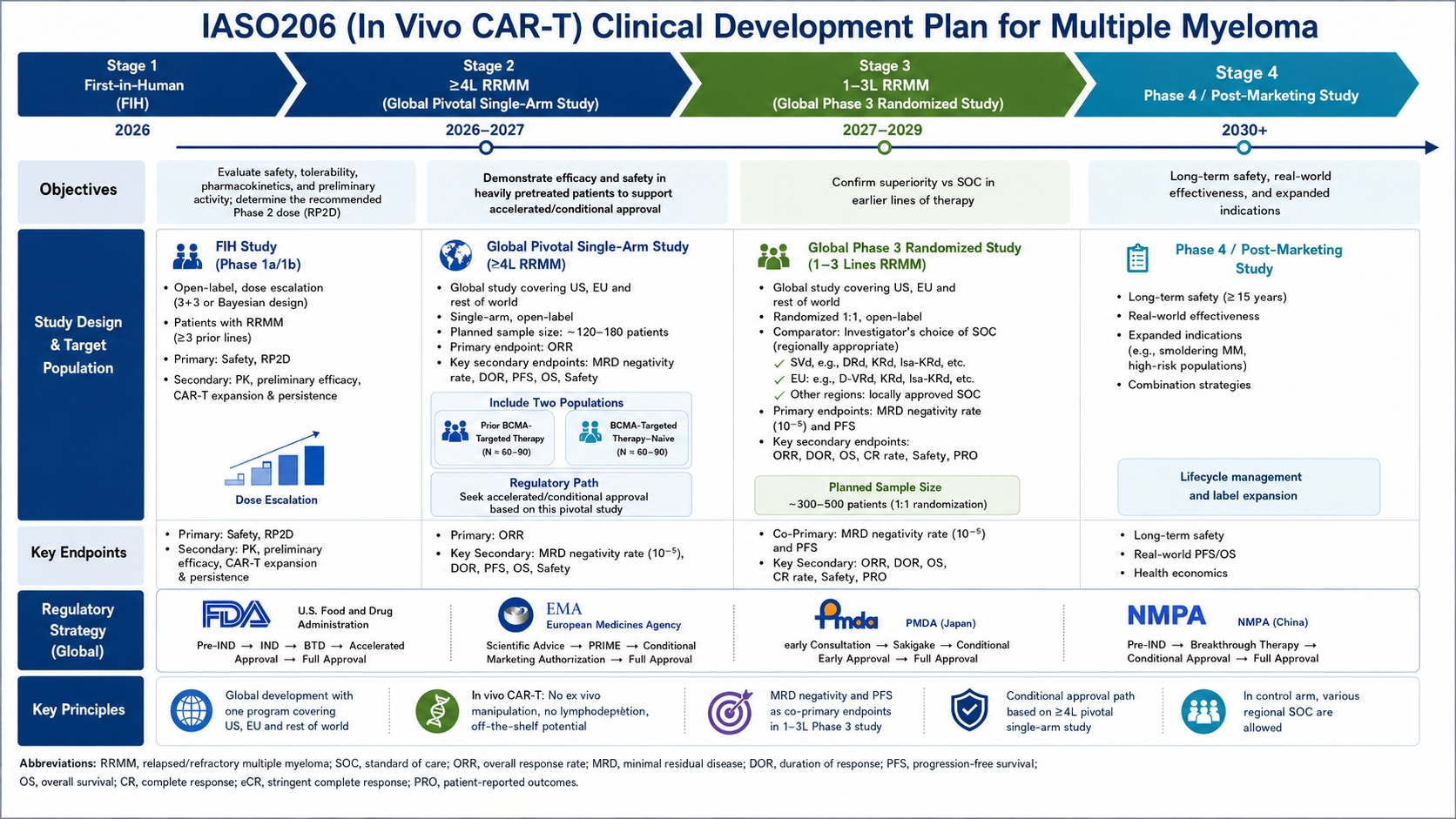
IASO206 is a BCMA-targeted in vivo CAR-T cell therapy for relapsed or refractory multiple myeloma (RRMM) — a single intravenous administration with no leukapheresis, no ex vivo manufacturing and no lymphodepletion — developed through a three-step registration pathway: FIH/Ib, a global single-arm pivotal study in >=4L RRMM, and a randomized Phase III confirmatory study in 1-3L RRMM.
Development Strategy
The program advances through four sequential stages, with conditional/accelerated approval sought on the >=4L pivotal package before or in parallel with the 1-3L confirmatory study. A direct head-to-head comparison with ex vivo CAR-T is not considered necessary.
| Stage | Timing | Core objective | Primary endpoint |
|---|---|---|---|
| Stage 1 — FIH (Phase Ia/Ib) | 2026 | Establish safety window, DLT/RP2D, in vivo CAR-T generation and PK/PD; China foundation | Safety / RP2D (DLTs, CRS/ICANS) |
| Stage 2 — >=4L global single-arm pivotal | 2026-2027 / 2027-2029 | Demonstrate efficacy and safety in heavily pretreated patients to support accelerated/conditional approval | ORR (with CR/sCR and MRD negativity) |
| Stage 3 — 1-3L randomized Phase III | 2027-2029 / 2028-2031 | Confirm superiority over regional standard of care in earlier lines | Co-primary: MRD negativity + PFS |
| Stage 4 — Phase IV / post-marketing | 2030+ | Long-term safety, real-world effectiveness, label expansion, lifecycle management | Long-term safety / RWE |
1. BCMA Target & Product
Target rationale
B-cell maturation antigen (BCMA, TNFRSF17 / CD269) is one of the most clinically validated targets in multiple myeloma. It is mainly expressed on mature B cells, plasma cells and malignant plasma cells, and is largely absent from hematopoietic stem cells and most normal tissues. Compared with CD38 (also on erythrocytes, platelets and immune-cell subsets) and SLAMF7 (also on NK and some T cells), BCMA provides a more selective plasma-cell lineage target. Soluble BCMA (sBCMA), generated by gamma-secretase cleavage, can reflect tumor burden and may interfere with BCMA-targeted therapies through competitive binding.
Four BCMA-targeted modalities
- ADC — Belantamab mafodotin is the benchmark; re-established in combination regimens, but ocular/corneal toxicity and monitoring remain key limitations.
- Bispecific / T-cell engagers — Teclistamab, elranatamab and linvoseltamab recruit endogenous T cells; off-the-shelf with no leukapheresis, but repeated dosing, infection risk, hypogammaglobulinemia and IVIG burden differentiate them from one-time therapy.
- Ex vivo (autologous) CAR-T — Ide-cel, cilta-cel, Eque-cel and zevor-cel deliver deep responses, but require leukapheresis, individualized manufacturing, vein-to-vein time, lymphodepletion, limited center capacity and high cost.
- In vivo CAR-T — Generates CAR-T cells directly inside the patient via a systemic gene-transfer vector (targeted lentiviral vector or LNP), eliminating leukapheresis, ex vivo culture and individualized manufacturing, and potentially avoiding lymphodepletion. IASO206 belongs to this emerging class; early proof-of-concept comes from ESO-T01 and KLN-1010.
IASO206 features (condensed)
- Vector design — optimized self-inactivating lentiviral vector carrying a BCMA CAR transgene, designed for selective in vivo transduction of circulating T cells.
- CAR structure — BCMA-binding domain, hinge/transmembrane region, 4-1BB costimulatory domain and CD3zeta signaling domain, aiming for memory-like CAR-T cells with durable activity.
- Simplified administration — single IV without leukapheresis, ex vivo manufacturing or lymphodepletion (central differentiation versus autologous CAR-T).
- Lower treatment burden — avoiding lymphodepletion may reduce cytopenia, infection risk, hospitalization and IVIG burden.
- Scalable manufacturing — batch-produced viral-vector manufacturing may support broader access, lower cost and better commercial scalability than individualized cell manufacturing.
Competitive comparison
Late-line efficacy benchmarks across approved BCMA bispecifics and CAR-T products (source figures, with conditioning/route context):
| Product | Modality | ORR | CR/sCR | Conditioning / administration |
|---|---|---|---|---|
| Teclistamab (Tecvayli) | BCMA x CD3 bispecific | ~62% | increases with longer follow-up | SC, step-up + continuous dosing |
| Elranatamab (Elrexfio) | BCMA x CD3 bispecific | ~61% | ~32% | SC, continuous (less frequent in responders) |
| Linvoseltamab (Lynozyfic) | BCMA x CD3 bispecific | ~71% | ~45% | IV step-up then maintenance |
| Ide-cel (Abecma) | Ex vivo CAR-T | ~73% | ~33% | Leukapheresis + lymphodepletion |
| Eque-cel (Fucaso) | Ex vivo CAR-T (IASO) | ~96% | ~74% | Leukapheresis + lymphodepletion |
| IASO206 | In vivo CAR-T | to be established | to be established | Single IV, no leukapheresis, no lymphodepletion |
Eque-cel (FUMANBA-1: ORR ~96%, CR/sCR ~74%) and cilta-cel (CARTITUDE — strongest ex vivo benchmark) anchor the deep-response bar; IASO206 should compete not on early ORR alone but on a full evidence chain of in vivo generation, persistence, MRD depth, durability, outpatient feasibility, lower infection/IVIG burden, scalability and long-term gene-therapy safety.
2. Business Value
Epidemiology
Multiple myeloma is the second most common hematologic malignancy, characterized by clonal plasma-cell expansion and end-organ damage (hypercalcemia, renal insufficiency, anemia, bone disease). Incidence rises strongly with age, and burden is expected to grow with population aging in both China and the United States.
- United States — approximately 35,000+ new MM cases annually, with a large prevalent population due to improved survival.
- China — approximately 30,000-35,000 new cases annually; lower age-standardized incidence but a large population base, with patients more often presenting at later stage with renal impairment.
Quantified unmet need
- Outcomes deteriorate with each additional line of therapy; late-line conventional regimens have limited ORR, short PFS and poor OS.
- Triple-class exposed/refractory patients have particularly poor outcomes and limited durable options.
- Ex vivo CAR-T provides deep responses but is constrained by leukapheresis, manufacturing time, center capacity, lymphodepletion, cost and manufacturing failure.
- Continuous T-cell-engaging antibodies are accessible but impose long-term dosing, infection monitoring, hypogammaglobulinemia, IVIG use and cumulative healthcare burden.
Eligible-patient funnel
| Population | United States | China | Relevance to IASO206 |
|---|---|---|---|
| Annual new MM cases | ~35,000+ | ~30,000-35,000 | Base incidence pool |
| >=2L RRMM | Large annual population | Large annual population | Future expansion area |
| >=3L / >=4L RRMM | Core late-line segment | Core late-line segment | First global single-arm pivotal pathway |
| CAR-T-eligible but untreated | Substantial access gap | Even larger access gap | Strong value for scalable in vivo product |
| 1-3L len-refractory, BCMA-naive | High strategic value | High strategic value | Randomized Phase III opportunity |
Market share (at maturity) & value
| Scenario | US share | China share | Key assumptions |
|---|---|---|---|
| Conservative | 8-12% | 15-20% | Slower approval, strong incumbents, limited differentiation |
| Base case | 15-20% | 25-30% | Timely approval, meaningful efficacy, favorable safety, lower burden, pricing below ex vivo CAR-T |
| Upside | 25-30% | 35-45% | Clear superiority in access/safety/durable MRD; successful earlier-line expansion |
Pricing should reflect the value of a one-time CAR-T-like therapy while acknowledging lower manufacturing complexity than autologous CAR-T — in the US, below ex vivo CAR-T but above annualized bispecific therapy if durability is proven; in China, lower pricing and reimbursement strategy will be central to uptake. A successful 1-3L randomized Phase III program would materially expand the peak-sales opportunity.
3. Clinical Trial Plan
Recommended sequence: (1) complete China FIH/Ib dose escalation and expansion; (2) fold the US, EU and other regions into one global program; (3) run the >=4L RRMM global single-arm pivotal study; (4) seek conditional/accelerated approval on that evidence; (5) directly run the 1-3L randomized Phase III confirmatory study versus regional SOC.
FIH / Ib (Phase Ia/Ib)
- Design — open-label dose escalation and expansion (3+3 or Bayesian).
- Population — RRMM, initially late-line; BCMA-targeted therapy-naive may be prioritized for mechanism demonstration.
- Objectives/endpoints — safety, DLTs, CRS/ICANS, in vivo CAR-T generation, vector biodistribution, viral shedding, RCL/RCR, insertion-site analysis; CAR transgene copies, CAR+ T-cell proportion, cytokines, ORR, CR/sCR, MRD negativity, DOR, PFS; define RP2D.
>=4L global single-arm pivotal
- Design — global, multicenter, open-label single-arm pivotal study covering US, EU and other major markets, with IRC assessment and central MRD testing.
- Population — >=4L RRMM in two prespecified cohorts: prior BCMA-targeted therapy and BCMA-targeted therapy-naive.
- Endpoints — primary ORR and/or CR/sCR with MRD negativity; key secondary: sustained MRD negativity, DOR, PFS, OS, safety, CRS/ICANS, infections, IVIG use, hospitalization, PROs, treatment-free interval.
- Sample size — approximately 120-180 patients overall, with cohort-specific assumptions and thresholds; final size depends on regulatory feedback and expected ORR/CR/MRD/DOR.
- Regulatory intent — support conditional/accelerated approval, then bridge to full approval.
1-3L randomized Phase III confirmatory
- Design — randomized, open-label, controlled Phase III; 1:1 randomization (no randomized Phase II validation step).
- Population — 1-3L RRMM; lenalidomide-refractory and BCMA-naive preferred.
- Comparator — IASO206 single IV at RP2D versus investigator-selected regional SOC (e.g. DPd, PVd, DVd, DKd/Kd, Isa-Pd); no ex vivo CAR-T comparator required.
- Endpoints — co-primary: MRD negativity + PFS; key secondary: CR/sCR, sustained MRD negativity, DOR, OS, safety, infection/IVIG burden, hospitalization, PROs, health economics. Stratify by prior lines, CD38 exposure/refractoriness, cytogenetic risk, ISS/R-ISS, renal function, region.
- Sample size — approximately 300-500 patients, 1:1, subject to MRD effect size, PFS hazard ratio, required events and regulatory alignment.
Phase IV / post-marketing
- Long-term follow-up for at least 15 years per gene-therapy expectations.
- Real-world effectiveness, safety, hospitalization, IVIG use, infection management and resource utilization.
- Expansion into earlier lines, high-risk populations, smoldering myeloma or combinations only after the core evidence package is mature; support conversion of conditional/accelerated approval to full approval.
4. Regulatory Considerations
IASO206 is both a cell-therapy-like immunotherapy and an in vivo gene-transfer product, so early engagement is essential. The first wave of questions covers classification, nonclinical package, vector targeting, RCL/RCR testing, insertion-site monitoring, viral shedding, reproductive risk, starting dose, DLT window, outpatient administration, CRS/ICANS management and long-term follow-up.
- FDA — position the >=4L global single-arm pivotal study as the first registration pathway via accelerated approval; align on single-arm acceptability, the two BCMA-exposure cohorts, MRD methodology, DOR/PFS maturity, the 1-3L confirmatory design, and LTFU obligations for an integrating vector.
- EMA — Scientific Advice on whether the >=4L study can support Conditional Marketing Authorization (CMA); GMO/environmental risk assessment, PIP timing, indirect contextualization versus ex vivo CAR-T/bispecifics, and acceptability of regional SOC control arms in the 1-3L study.
- NMPA — China FIH safety, dose selection, bridging to global data, MRD-testing consistency, role versus approved China BCMA CAR-T, and feasibility of conditional approval on global pivotal data plus China-specific evidence.
- PMDA — early engagement on Japan participation, bridging needs, LTFU, and Sakigake or conditional early approval if substantial benefit is shown.
5. Strategy & Governance
Milestones (key dates)
| Period | Milestone |
|---|---|
| 2026-2027 | China FIH/Ib dose escalation and early expansion; initiate US/EU/Japan regulatory engagement |
| 2027-2029 | Launch and execute >=4L global single-arm pivotal study; prepare conditional/accelerated approval package |
| 2028-2031 | Initiate and execute 1-3L randomized Phase III confirmatory study |
| 2030+ | Potential conditional/accelerated approval, confirmatory data maturation, post-marketing studies, lifecycle expansion |
Go/No-Go criteria (four dimensions)
| Domain | Go (continue) | No-Go (terminate / pause) |
|---|---|---|
| Safety | Manageable CRS/ICANS, acceptable cytopenia/infection profile, no concerning vector signal | Unacceptable grade >=3 toxicity, uncontrolled neurotoxicity, RCL/RCR detection or insertional safety signal |
| Efficacy | Meaningful MRD negativity, ORR/CR/sCR, DOR and PFS in both BCMA-exposure cohorts | Weak depth, poor durability, no benefit over available therapies, or poor activity in BCMA-naive patients |
| Mechanism / CMC | Reproducible in vivo CAR-T generation and persistence; scalable vector manufacturing with consistent potency | Highly variable transduction, no dose-exposure-activity relationship, uncontrolled batch variability or failed comparability |
| Commercial | Clear differentiation in access, convenience, treatment burden, cost and synergy with Eque-cel | No credible differentiation from bispecifics/ex vivo CAR-T or insufficient payer value |
Differentiated evidence package
The program should prospectively capture in vivo CAR-T generation and persistence, MRD negativity and sustained MRD negativity (at 6 and 12 months), PFS, DOR, ORR/CR/sCR, reduced burden from no lymphodepletion, grade >=3 infections and IVIG use, outpatient feasibility, and long-term monitoring for insertional mutagenesis and RCL/RCR. IASO206 should be positioned as complementary to, not cannibalistic of, Eque-cel — the mature ex vivo BCMA CAR-T asset in China — expanding access through a scalable, no-leukapheresis, no-lymphodepletion approach, with shared KOL networks, treatment-center education, MRD/safety infrastructure and BCMA sequencing strategies.